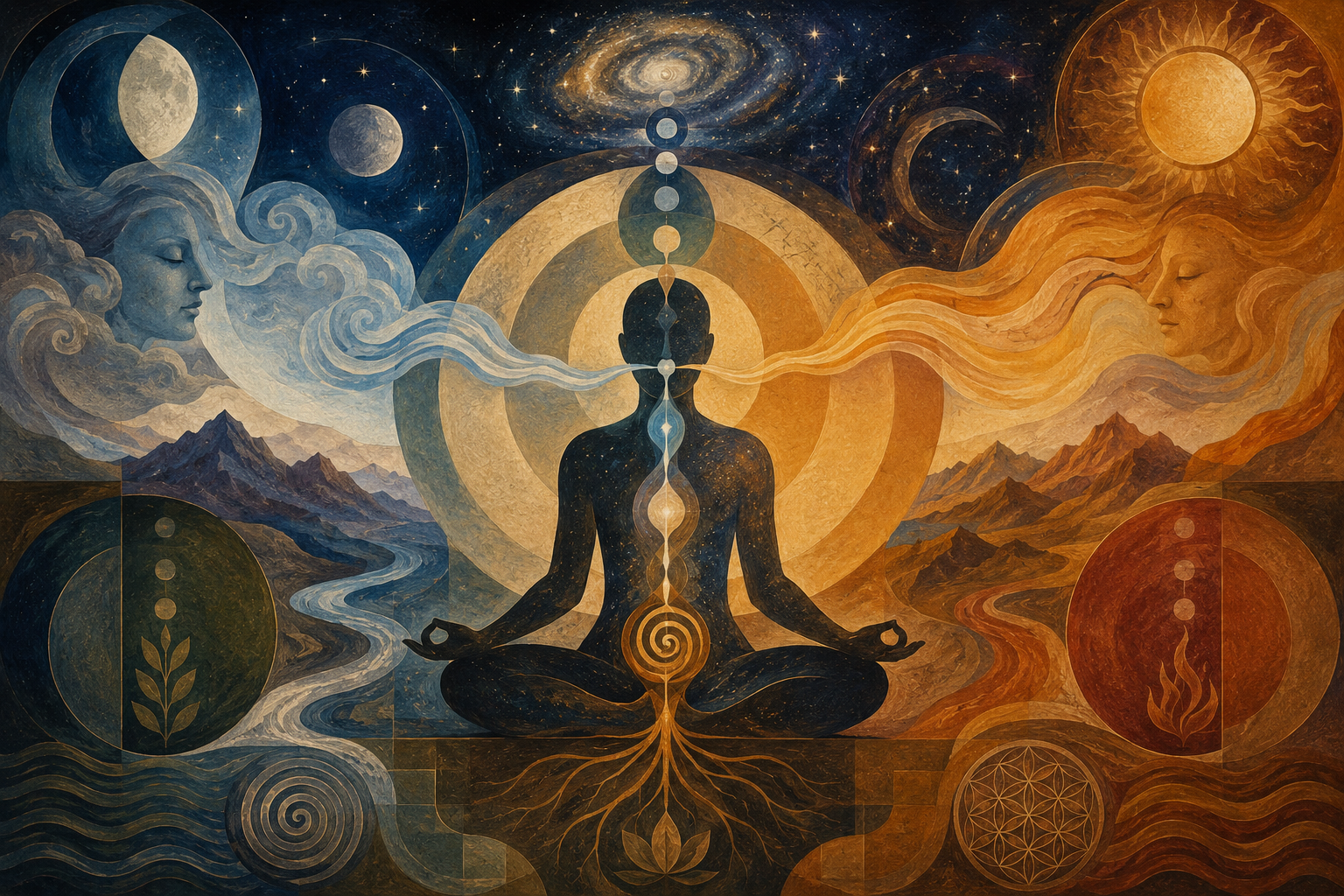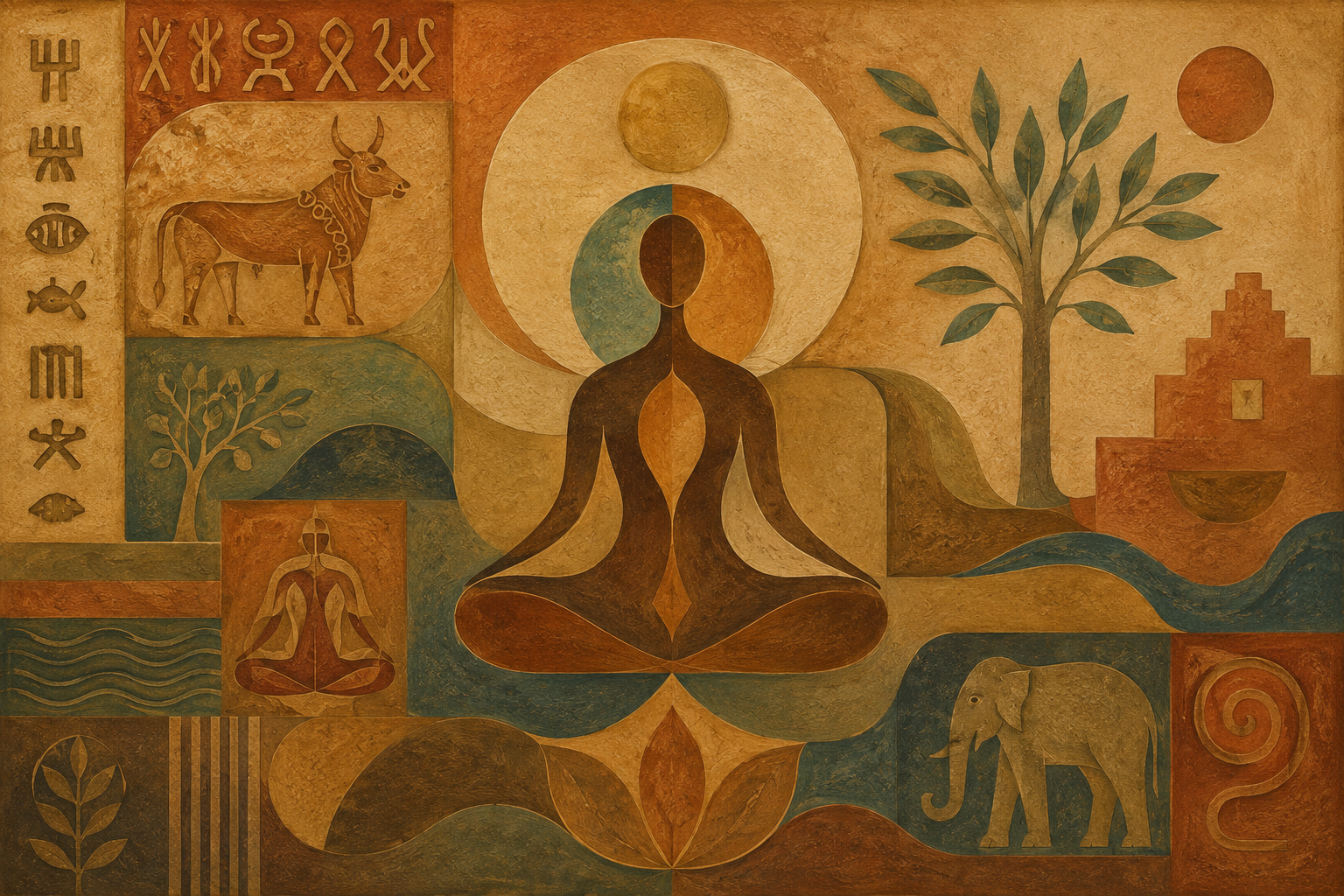
Every great system that endures for thousands of years does so because it is, at its core, functional. It works. Religions splinter, empires collapse, technologies become obsolete within a generation — but yoga, a philosophy first articulated in the forests and river valleys of ancient India, is still practiced today with almost no revision to its central instructions. That kind of endurance is not an accident of culture. It is the signature of something closer to a code — a precise, tested, repeatable set of instructions for what it means to be human.
An Operating Manual, Not a Belief System
It's tempting to think of yoga as spirituality in the soft sense — stretching, breathing, a bit of calm. But the original texts read less like devotional poetry and more like an engineering manual for consciousness. Patanjali's Yoga Sutras, composed roughly two thousand years ago, open with a definition so precise it could be a line of pseudocode: yogas citta vritti nirodhah — yoga is the cessation of the fluctuations of the mind. Everything that follows is procedural. Sit like this. Breathe like this. Direct attention like this. Observe what happens. Repeat.
This is the first clue that yoga functions as a code rather than a creed: it does not ask for belief. It asks for execution. The eight limbs — moral restraint, personal discipline, posture, breath control, sense withdrawal, concentration, meditation, and absorption — are not doctrines to accept on faith. They are sequential steps, each one a prerequisite for the next, exactly like a well-structured program where each function depends on the one before it running correctly.
Conquering the Body
The physical practice — asana — is often mistaken as the whole of yoga in the modern world, but within the original system it plays a specific and limited role: to make the body a stable, obedient instrument rather than a source of constant distraction. An untrained body interrupts the mind with hunger, restlessness, pain, and fatigue at the worst possible moments. Asana is the debugging process for the body — locating its weaknesses, its stiffness, its imbalances, and systematically resolving them so the body no longer hijacks attention.
This is conquest not in the sense of domination, but in the sense of mastery — the same way an athlete "conquers" their sport, or a craftsman "conquers" their material. The yogi does not fight the body; the yogi trains it until it complies effortlessly, freeing enormous reserves of energy and attention for what comes next.
Conquering the Environment
Beyond the body, the yogic code addresses the practitioner's relationship to the external world through the yamas and niyamas — the ethical restraints and observances that form the first two limbs. Non-violence, truthfulness, non-attachment, contentment, self-discipline: these are not moral suggestions handed down for their own sake. They are, functionally, environmental optimizations. A person who lies creates conflict that consumes mental bandwidth. A person who is envious or attached to possessions is perpetually reactive to circumstances outside their control. A person who practices contentment is far less destabilized by an unpredictable world.
In this light, yogic ethics are not about being "good" — they are about reducing the noise generated by one's own interactions with the environment, so that the environment stops running the mind and the mind can begin running itself.
Conquering the Mind — and Reaching the Self
Only after the body is stabilized and the environment is no longer a source of chaos does the code turn inward, toward the mind itself. Pratyahara withdraws attention from the senses. Dharana trains one-pointed concentration. Dhyana extends that concentration into sustained, uninterrupted meditation. And finally, samadhi — absorption — is the state in which the boundary between observer and observed dissolves, and the practitioner glimpses what yoga considers the true self beneath all the layers of body, breath, environment, and thought.
This final stage is the output the entire code was written to produce: self-realization. Not self-improvement, not stress relief, not flexibility — though these may arise along the way — but a direct recognition of one's own essential nature, unclouded by the noise the earlier limbs were designed to eliminate.
Why the Code Still Compiles Today
What makes yoga remarkable is not that it proposes a beautiful idea, but that it proposes a testable one. Practice the postures, and the body changes. Practice the breath, and the nervous system changes. Practice concentration, and the quality of attention changes. Each layer produces a verifiable result, which is why the system has survived contact with vastly different cultures, languages, and centuries without needing to be rewritten. A philosophy that requires blind faith erodes under scrutiny. A code that produces consistent results simply gets used, generation after generation, by anyone willing to run it.
In a modern life crowded with unstable bodies, chaotic environments, and restless minds, yoga remains what it has always been: not a relic of ancient superstition, but a working system — tested across millennia — for anyone ready to execute it.
The code is open source. It has been for thousands of years. All it requires is that you run it.