There is a rhythm that has never stopped since the moment you were born. It does not pause for your worries, does not wait for your permission, and asks nothing of you except your attention. It is the breath — the most ordinary miracle of being alive, and the foundation of one of yoga's most profound practices: Pranayama.
The word pranayama comes from two Sanskrit roots: prana, meaning life force or vital energy, and ayama, meaning to extend, draw out, or restrain. Together, they describe something far larger than "breathing exercises." Pranayama is the art and philosophy of consciously working with the life force that animates every living thing — using the breath as the doorway.
Breath as the Bridge
In yogic philosophy, prana is not confined to oxygen or air. It is the subtle energy that moves through all things — the current beneath thought, digestion, circulation, and even emotion. The ancient yogis observed something remarkable: while most bodily functions operate outside conscious control, the breath sits at a unique threshold. It happens automatically, yet you can also direct it at will.
This makes breath the bridge between the voluntary and involuntary, between the body and the mind, between the seen and the unseen. To work with the breath, the yogis understood, is to gain a handle on the mind itself. When breath is erratic, the mind is restless. When breath is steady and slow, the mind settles. Pranayama, then, is not merely a physical technique — it is a psychological and spiritual technology for steadying consciousness.
The Fourth Limb
In the classical framework laid out by the sage Patanjali in the Yoga Sutras, Pranayama is named as the fourth of the eight limbs of yoga — arriving right after the physical postures (asana) and before the withdrawal of the senses (pratyahara). This placement is deliberate. Pranayama is the hinge between the outer practices of the body and the inner practices of the mind. It marks the point where yoga stops being merely physical and begins turning inward.
Patanjali describes pranayama as the conscious regulation of the natural rhythm of inhalation and exhalation. But its purpose reaches further than calming the nerves. It is described as a means of thinning the veil — the layer of mental noise and restlessness that obscures clarity, or what the yogis called avidya, ignorance of one's true nature. As the breath is refined, the mind becomes a clearer instrument, capable of the deep concentration and meditative absorption described in yoga's later limbs.
The Subtle Body and the Flow of Prana
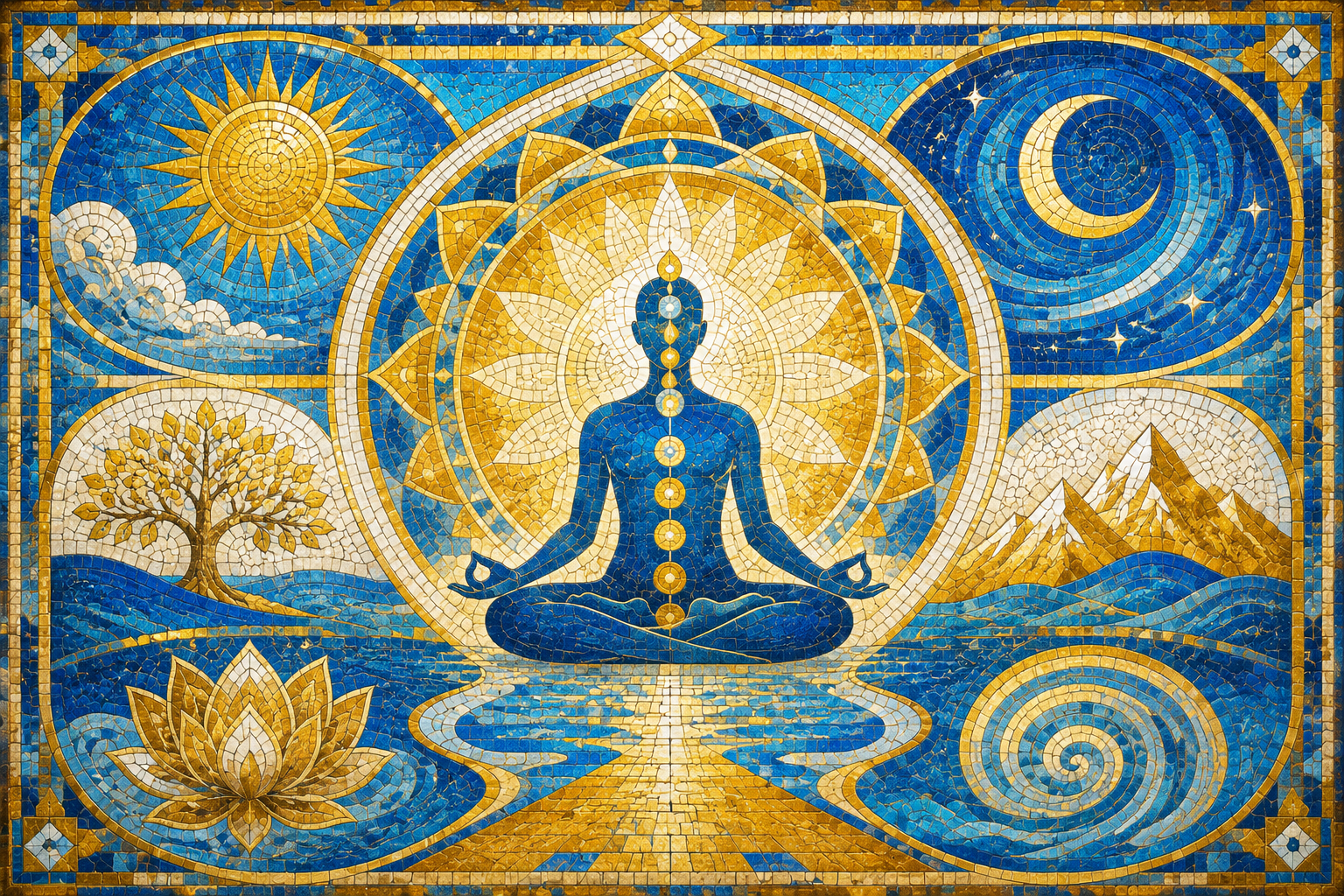
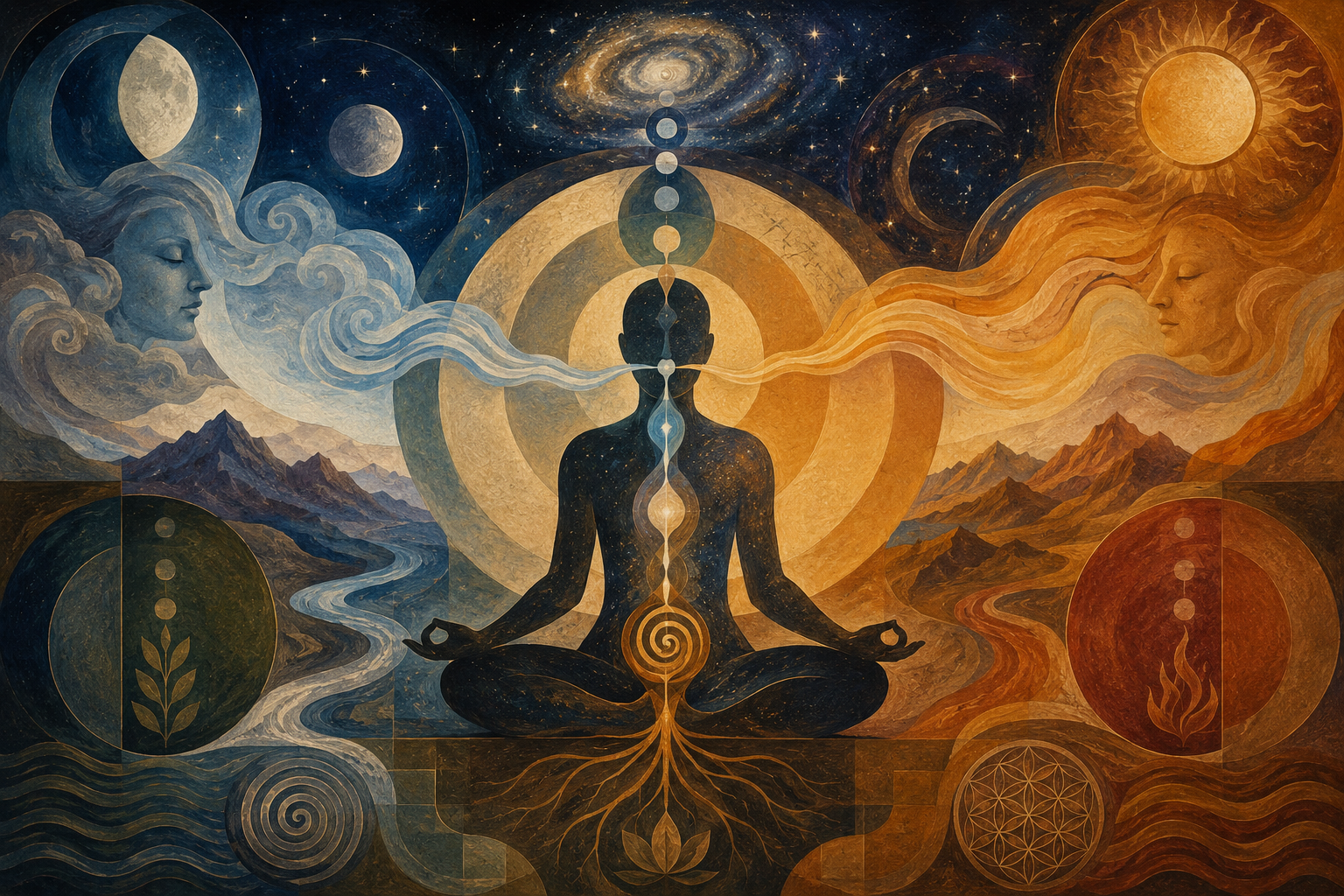
Yogic anatomy describes an unseen architecture running alongside the physical body: a network of subtle channels called nadis, through which prana flows, and centers of concentrated energy called chakras. Among the thousands of nadis, three are considered central — ida, associated with the cooling, lunar, receptive quality of mind; pingala, associated with the heating, solar, active quality; and sushumna, the central channel, through which awakened energy is said to rise toward higher states of consciousness.
In this view, most people live with prana flowing unevenly — too much heat, too much restlessness, or too much dullness and inertia. Pranayama practices are designed to balance ida and pingala, so that prana can flow freely through sushumna. This balancing is not just symbolic; practitioners often report a tangible sense of equilibrium after sustained practice — a mind neither agitated nor sluggish, but clear and awake.
Beyond Technique: A Philosophy of Attention
It would be easy to reduce pranayama to a set of counted breaths — four seconds in, hold, six seconds out. And indeed, the techniques matter. But the deeper philosophy asks something more: that the breath be met with full presence. Each inhalation becomes an act of receiving, each exhalation an act of release. Practiced this way, pranayama becomes a rehearsal for how to meet life itself — taking in what nourishes, letting go of what no longer serves, and resting, briefly, in the stillness between.
This is why the ancient texts speak of the breath as sacred. Every inhale is a small beginning. Every exhale is a small ending. Between them lies a pause that mirrors the vastness yogis sought through meditation — a taste of the silence beneath all mental activity. To practice pranayama with awareness is to practice dying and being reborn, moment after moment, breath after breath.
A Practice for the Nervous System — and the Soul
Modern science has begun to validate what yogis intuited millennia ago: slow, controlled breathing shifts the body from a state of stress activation toward one of calm regulation, influencing heart rate and the nervous system's balance between alertness and rest. But the yogic tradition never separated the physiological from the spiritual. A calm nervous system was always understood as the ground for something greater — the possibility of turning attention inward, quieting the fluctuations of the mind, and glimpsing a deeper, unconditioned awareness beneath the noise of ordinary experience.
This is the ultimate aim of pranayama in yogic philosophy — not relaxation for its own sake, but relaxation as a gateway to self-realization. The breath, worked with skillfully and reverently, becomes a teacher. It shows us that stillness and movement are not opposites but partners, that control and surrender can coexist, and that the path to the infinite may begin with something as simple, and as eternal, as the next breath you take.
Whether you're new to pranayama or deepening a long-standing practice, the invitation is the same: sit, breathe, and notice. The eternal breath is always available — waiting, as it always has, for your attention.